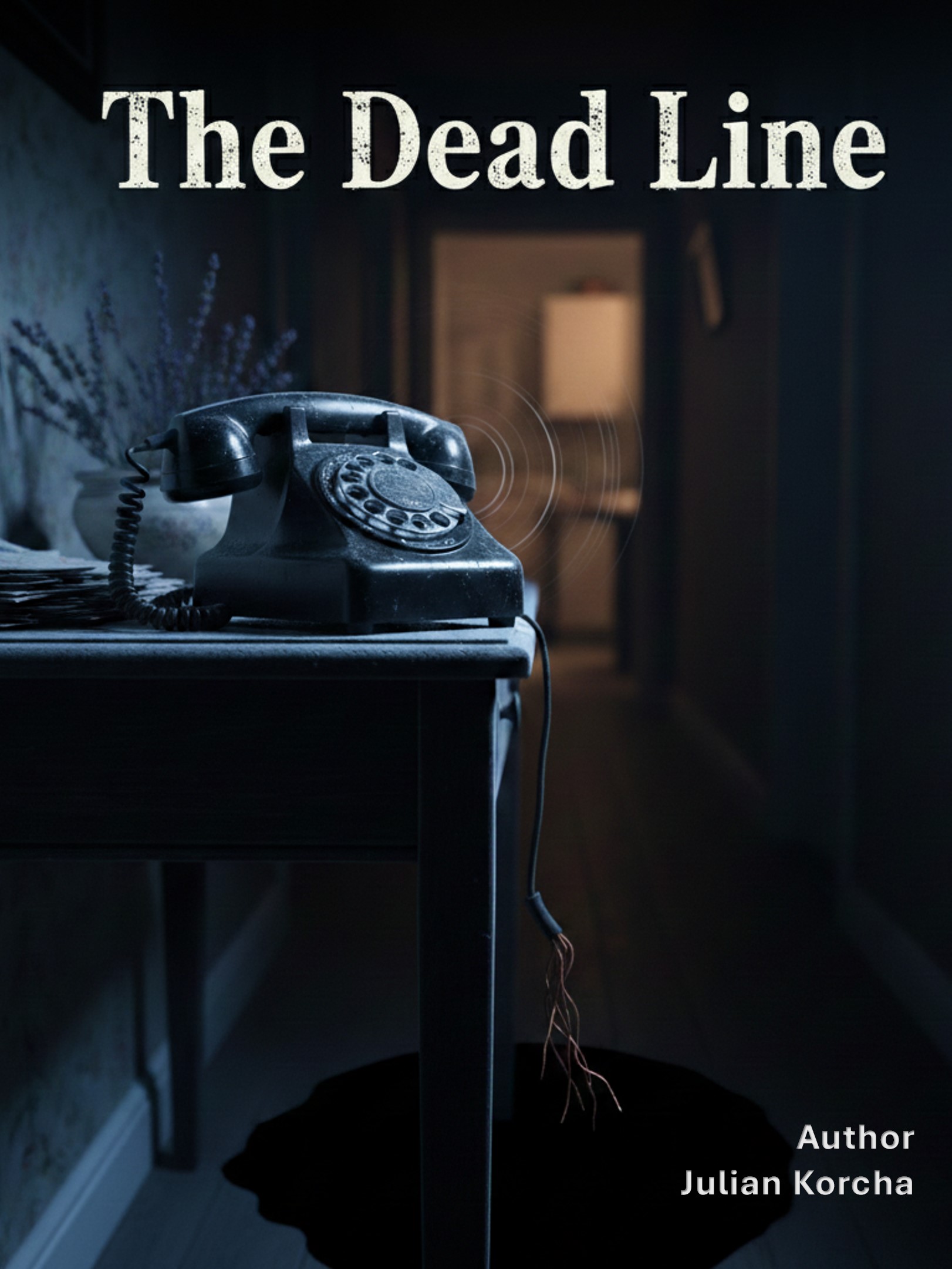
The Dead Line
When an unplugged rotary phone starts delivering calls from the dead, Emily keeps answering until one caller claims to be her still-living husband and begs for help.
Description
The phone has no cord. No line. No connection to anything. It rings anyway.
Archivist Emily Patton brings home a vintage rotary phone from a rain-soaked estate sale - and at 2 AM, it rings. The voice on the other end belongs to her best friend. The friend who died four years ago.
The calls keep coming. The dead reach out with apologies, memories, and comfort she never expected to hear again. Emily tells no one - not even her husband.
Then one night, the phone rings… and for the first time, the caller is not dead.
A chilling psychological thriller about grief, obsession, and the price of holding on.
Get It
- Get for free on Barnes & Noble: The Dead Line
- Buy on Amazon: The Dead Line
Themes
- Grief, longing, and unresolved loss
- Haunted objects and supernatural intrusion
- Obsession, secrecy, and emotional dependency
- Identity slippage and domestic dread
- Psychological horror rooted in ordinary life
Chapter 1: Static
The estate sale was a wet, miserable affair: card tables sagging under the weight of rain-warped paperbacks, porcelain figurines with chipped noses arranged on damp towels, and the accumulated possessions of someone who had clearly died without anyone who wanted their things.
Emily moved through the rows with the detached attention of a professional scavenger. She was an archivist by trade, a restorer of old documents and forgotten instruments at the university library, and she had a weakness for objects that carried the weight of time. A brass compass with a stuck needle. A set of ivory-handled letter openers. A mantel clock that had not ticked since the Carter administration.
She did not need any of it. She bought it anyway.
It was the collecting that kept her level. After Belle’s accident, the phone call at one in the morning, the hospital’s fluorescent indifference, the casket that seemed obscenely small for someone who had taken up so much space in the world, Emily had stopped crying and started acquiring. A Victorian writing desk. A 1920s typewriter with a missing E key. Objects that had survived their owners, that proved something could outlast grief.
David said it was a phase. He said it gently, the way he said most things, while picking up Thai food and not mentioning the new stack of estate sale finds cluttering the hallway. He was patient with her in the way that only someone who genuinely loved the worst parts of you could be. He left dishes in the sink and she stole his socks and neither of them had remembered their anniversary last year until two days after, at which point they had looked at each other over leftover pasta and burst out laughing.
She missed him already, even though he was at home.
That was the thing about grief: it taught you to rehearse loss. Every time David left for school, he taught music at the high school, choir and beginning guitar, and came home most days smelling of whiteboard markers and adolescent chaos, some small, broken part of her brain whispered: What if this is the last time?
The phone was on a table near the back, half-hidden under a crocheted blanket that smelled of mothballs. Heavy black Bakelite, a rotary dial with satisfying mechanical resistance, and a receiver that fit the hand like it had been designed for the specific architecture of human fingers. It was a 1940s model, she guessed. No branding. No manufacturer’s mark. The cord was severed, frayed rubber and a twist of copper wire dangling from the base like a tail.
“Five dollars,” the man running the sale said. He was sitting under a golf umbrella, cigarette going, not looking at her. “Everything on that table’s five.”
“Whose estate is this?”
The man shrugged. “Some old guy. No family. Landlord hired me to clear it.” He squinted at the phone in her hands. “Do not remember putting that out, actually.”
Emily turned the dial. Click-whirr-click. The sound was deeply satisfying, the kind of engineered precision they did not bother with anymore. She put five dollars on the table.
At home, she placed it on the hallway console, next to the bowl of dried lavender and the stack of mail neither of them ever sorted. David came out of the kitchen, dish towel over his shoulder, and raised an eyebrow.
“What’s that?”
“A phone.”
“We have a phone.”
“Not like this.” She adjusted its position, angling the receiver just so. “It’s aesthetic.”
“It’s a dead phone in a hallway.” He kissed her forehead. “You’re running out of surfaces, Em.”
She smiled, and the smile was real, and the house was warm, and the phone sat silent on its table like a small black monument to a disconnected past.
Three weeks later, at 2:14 in the morning, it rang.
The sound ripped Emily from sleep like a hand through paper. It was not a digital tone. It was mechanical, physical, a steel clapper striking a brass bell inside the housing with a violence that vibrated through the floorboards and into the bones of her feet when she stood.
David did not stir. He slept like the dead, always had, one arm thrown across the mattress where her body had been.
She padded to the hallway. The phone sat on the console, exactly where she had left it. The severed cord trailed over the edge, connected to nothing. The receiver was rattling in its cradle from the force of the bell.
It could not ring. There was no mechanism. No current. No line.
It rang again.
Emily lifted the receiver. The Bakelite was ice-cold against her ear.
“Hello?”
Static. Deep, oceanic static, the sound of distance itself, of a signal traveling through something thicker than air.
“Emily? Is that you? It sounds like you’re underwater.”
She stopped breathing. The voice was tinny, compressed by layers of interference, but she knew it the way she knew her own pulse. The cadence. The slight rasp from years of chain-smoking in college. The warmth.
“Belle?”
“I’ve been trying to reach you,” the voice said. “It’s so quiet here. I just wanted to hear your voice.”
Belle had died in a car accident four years, two months, and eleven days ago. Emily knew the count because she had never stopped keeping it.
“Belle, you’re - this is not -”
“I know, honey. I know. It’s okay. It’s warm here, in its way. Peaceful. I just miss talking, you know? I miss the sound of someone breathing.”
They talked for ten minutes. Belle mentioned the hydrangeas Emily had planted last spring and asked about the cat they had talked about getting in college. She sounded exactly like herself: scattered, affectionate, prone to tangents. When the line went dead, there was no click, no dial tone. Just a sudden, heavy silence, as if the air in the hallway had thickened and settled.
Emily stood in the dark for a long time, the dead receiver pressed to her ear, listening to nothing.
She did not go back to bed. She turned on the television in the living room, volume low, and left the hallway light on, and sat on the couch with a blanket pulled to her chin, the blue flicker of the screen filling the room with the comfortable illusion of company. She did not sleep. She did not try. She just sat in the manufactured light and waited for her heart to stop hammering.
It became a habit. After the calls, after any call, she would turn on the TV and the hallway light and sit in the warm glow until the fear thinned enough to let her breathe. David never asked why. He slept through everything.
The calls continued.
They never came when she expected them. They came at odd hours: 3 AM on a Thursday, dusk on a Wednesday while she was making dinner, mid-morning on a Saturday while David was out for a run. The phone would trill its impossible mechanical scream and Emily would drop whatever she was holding and run to the hallway, heart hammering, palms slick.
Her grandmother called second, on a Sunday afternoon while David was mowing the lawn, the sound of the engine a distant drone beneath the phone’s static. The voice was more distant this time, buried deeper in the interference, but the tone was unmistakable: clipped, no-nonsense, tinged with the faint accent of a woman who had grown up speaking Mandarin before English. She wanted Emily to know that the apple cake recipe in the family cookbook was wrong. Too much cinnamon. She always meant to fix it. Use nutmeg instead. A quarter teaspoon. Write it down. And then, softer: You look tired. You’re working too hard. Eat more. Sleep more.
Mr. Henderson called to apologize for a detention he had given her in 1998. Uncle Mike called and mostly breathed on the line, and then said he was proud of her before the static swallowed him again.
Belle called twice more. The second time, she talked about a college concert they barely remembered and laughed in that same old way that made Emily feel nineteen and unbroken for a few brief seconds.
Each call left Emily hollowed and filled at the same time, scooped out by the impossibility of it, then flooded with a warmth she had not felt since before Belle’s funeral. The phone was a confessional for the departed, a bridge of static and Bakelite that bypassed the grave. She did not understand it. She did not try to. She just answered, every time, because every ring might be the last one.
She did not tell David.
This was hers. This impossible, precious thing. Hers.
On a cool night, nearly six weeks after the first call, Emily sat alone in the hallway, the house dark and still. She set her wine down and put her hand on the phone.
“I do not know what I’d do,” she whispered, “if I ever lost him too.”
The phone said nothing. But beneath her hand, she thought she felt a vibration, faint and almost subliminal, as if something on the other end had heard her and leaned closer.